
Energy management Start: energy consumption monitoring per ISO 50001
Start automatically collects data from meters and IoT sensors and shows energy consumption in 15-minute intervals. You see where energy is lost, get alerts on deviations, and have the data you need for decisions and ISO 50001 certification.
Who the Start level is for
- ISO 50001Companies that are implementing or already have ISO 50001 and need continuous data.
- Energy and facility managersThose who read meters manually today.
- Production managementProduction directors who want to know how much energy each hall and line consumes.
What Start energy consumption monitoring can do
Everything from the ISO Base level, plus:
- Automatic data collection from electricity meters, gas meters, heat meters, water meters and IoT sensors
- Online energy consumption overviews by building, hall, technology and production line
- 15-minute data and comparison of shifts, days and months
- Deviation alerts, for example air handling or compressors running outside production hours
- EnPI indicators calculated automatically from metering against the baseline (EnB)
- Register of measures and evaluation of their actual savings
- Reports for management and for the ISO 50001 management review of the system
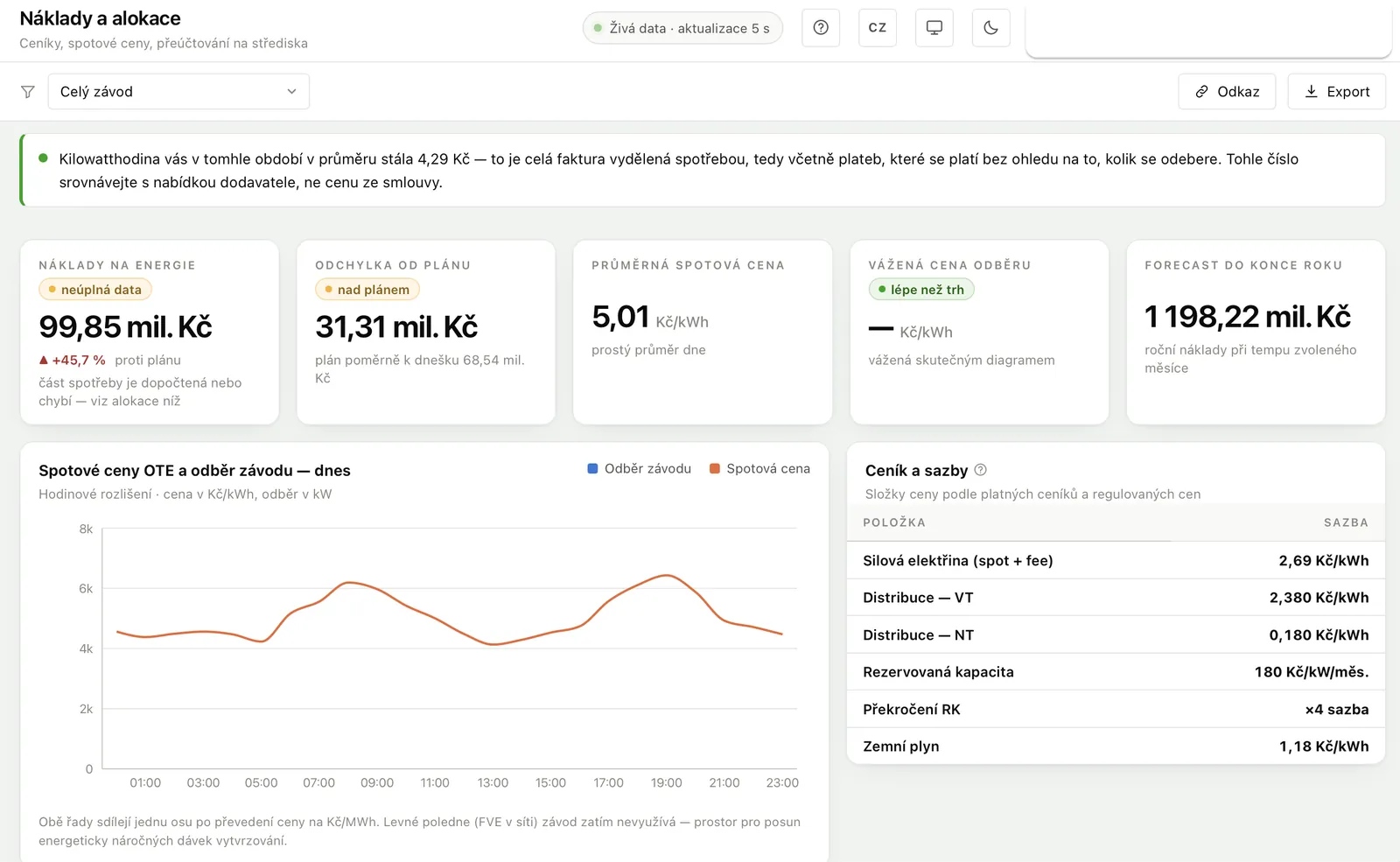
Consumption, peaks and deviations in one place
Click an image to enlarge it.
We connect your meters and new IoT sensors
We use your existing billing meters and sub-meters and add IoT sensors where data is missing. Wireless LoRaWAN or NB-IoT meters suit sub-circuits without cabling. Distributor data and manual readings can be connected too.
| Protocols | Modbus RTU / TCP, M-Bus, wM-Bus, OPC UA, Siemens S7, MQTT, LoRaWAN, NB-IoT, S0, REST / CSV / SFTP |
|---|---|
| Media | Electricity, natural gas, compressed air, heat, cooling, water, heat recovery, PV, temperature and humidity |
| Collection interval | 1 s – 15 min depending on the device, aggregation 15 min → hour → day → month |
| Hierarchy | Plant → hall → operation → line → machine; technological, cost and energy views |
| Alarms | Threshold, anomaly against profile, consumption outside production hours, 15-minute peak demand; e-mail, SMS, Teams, push, webhook |
| Integrations | MES, ERP, SCADA / BMS, CMMS, weather, OTE spot prices, REST API and webhooks, SSO (Entra ID) |
| Deployment | On-premise in the customer's data center or Microsoft Azure; edge gateway with store-and-forward |
| Security | Roles and permissions per hierarchy node, audit log, encryption of transmission and data, separation of OT and IT networks |
How we deploy energy consumption monitoring
Metering design
We review your meters and propose additions.
Installation
We install sub-meters and IoT sensors.
Connection
We connect all metering to Energy Infra Scan.
Setup
We define the baseline, indicators and alert rules.
Operation
We evaluate consumption with you and propose measures.
Consumption monitoring in practice
For KYB Czech Republic we are implementing metering of air handling, heat recovery, cooling, heating and ventilation in the production hall.
Energy consumption monitoring FAQ
Which meters can the platform read?
Electricity meters, gas meters, heat meters, water meters, flow meters and IoT sensors. We communicate via Modbus RTU/TCP, M-Bus and wireless M-Bus, OPC UA, MQTT, LoRaWAN and NB-IoT, S0 pulse outputs and REST/CSV import.
How often is data updated?
We set the collection interval for each device from 1 second to 15 minutes. By default we evaluate consumption in 15-minute intervals.
Where is the data stored?
We deploy the platform in the customer's data center (on-premise) or in the Microsoft Azure cloud. Transmitted and stored data are encrypted, and the edge gateway on site keeps the data even during a network outage.
Does Start help with ISO 50001 certification?
Yes. Start provides the metering, EnPI indicators and reports that ISO 50001 requires. We arrange the documentation and processes with QC Group.
See your energy consumption in a new way
We will show you the platform on sample data from a production hall and design metering for your plant.